
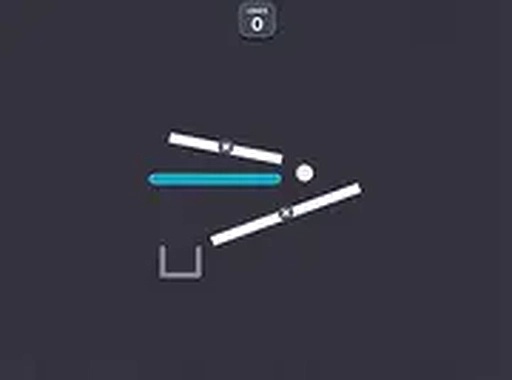
Trace Route Logic
Reviews
Trace Route Logic builds its challenge around one clear idea: draw a line, then watch balls follow it. The absence of timers and scores puts the focus entirely on planning and observation. Obstacles like walls and gaps force you to think about elevation and curvature rather than just connecting two points. The gradual level progression and the ability to replay stages give it a relaxed but thoughtful pace. It suits players who prefer deliberate problem solving over fast reactions.
About this game
Drawing as the Core Puzzle Mechanic
Trace Route Logic turns line drawing into the primary problem-solving tool. Each stage presents a starting marker and a designated finish area. You draw a continuous line between them, and once the route is set, small balls roll along it, responding to every curve, angle, and change in elevation. A straight path may suffice in early stages, but later layouts require loops, sharp turns, and deliberate height changes to keep the balls moving toward the target. The challenge comes from predicting how the balls will behave on the shapes you create.
Obstacle Placement and Route Planning
Barriers appear throughout each stage, and they influence where your line can go. Fixed walls force you to draw around them, while gaps require you to build a bridge with your line. Because there are no timers, you can study the entire layout before drawing anything. This encourages a methodical approach: identify where balls might get stuck, plan a route that avoids those trouble spots, and combine multiple segments into one smooth line. The eraser tool lets you remove mistakes without restarting the level.
Progression Without Pressure
Levels are arranged in a sequence that gradually increases in complexity. Early stages introduce basic drawing and simple obstacle avoidance. Later stages combine multiple hazards and longer paths that demand more careful planning. There is no scoring system and no time limit, so the only goal is to deliver all balls to the target. This relaxed structure supports both short play sessions and longer, focused puzzle solving. Completed levels can be revisited to try alternative solutions.
Visual Style and Controls
The game uses a clean, minimal visual design with clear indicators for the start point, goal area, and obstacles. Brightly colored balls make it easy to follow their movement along the drawn path. Controls are simple: click or tap to draw, and use the eraser tool to remove mistakes. The interface works with both touchscreens and mouse input, and the game can be played in full screen mode for better visibility. No downloads or installations are required.
Compatibility
FAQ
Comments
Sign in to leave a review
No comments yet.





Editorial Notes